

AI4MiddleSchools Expands Nationwide Effort to Prepare Middle School Students for an AI-Powered Future
AI4MiddleSchools Expands Nationwide Effort to Prepare Middle School Students for an AI-Powered Future
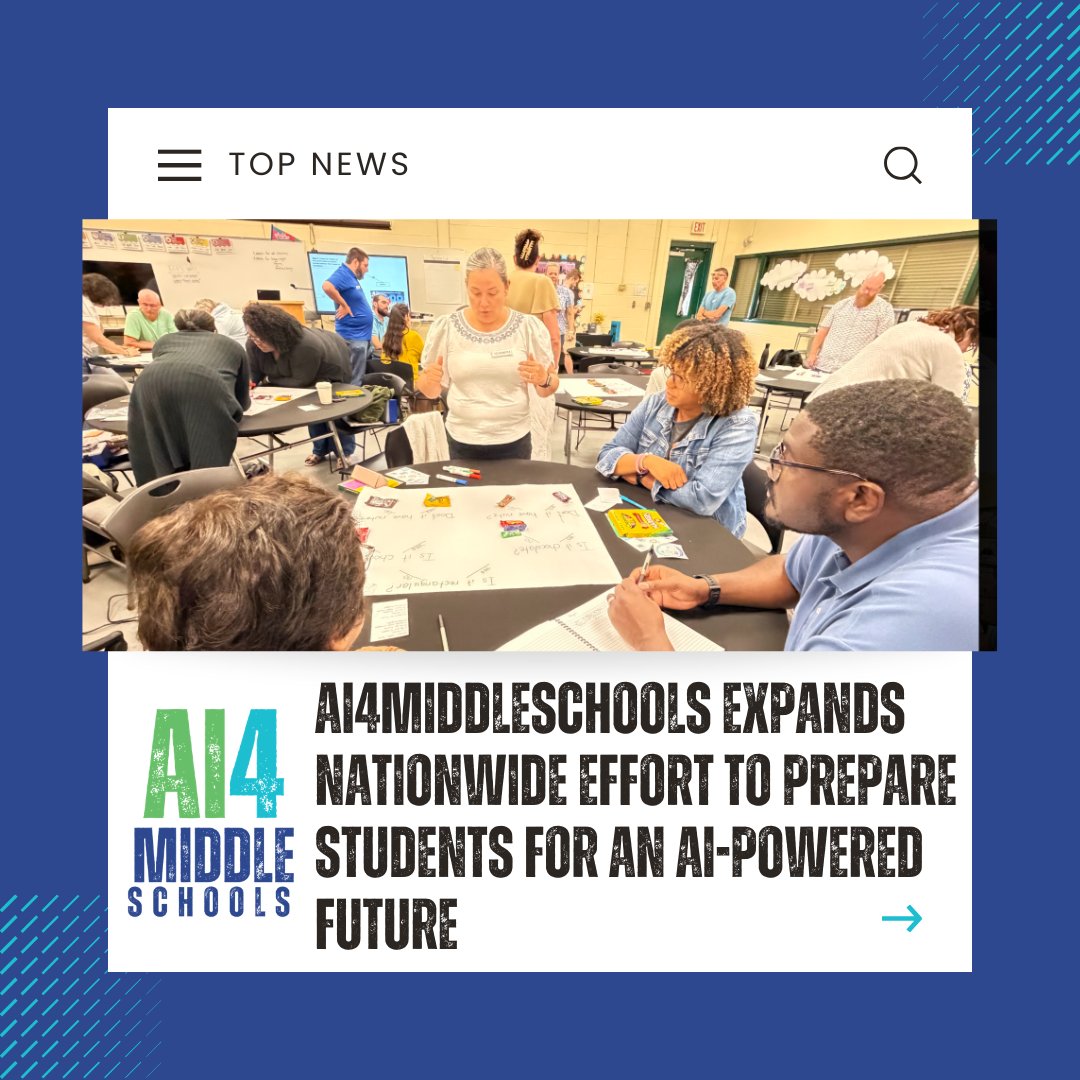
Austin, Texas — As students and educators across the country head back to school, a growing multi-state partnership is helping middle schools prepare students for a world increasingly shaped by artificial intelligence.
AI4MiddleSchools is expanding its work to help educators teach students not simply how to use artificial intelligence, but how AI works, how it affects society, and how they can become informed creators of technology. The initiative brings together universities, education organizations, school districts, and educators to build sustainable AI education pathways for middle school students.
The expansion builds on foundational work supported by the National Science Foundation (NSF) and industry partners. This year, we bring the AI4MiddleSchools program to new communities in Connecticut, Mississippi, New Jersey, and Pennsylvania while deepening implementation in Georgia, Texas, and Florida.
AI4MiddleSchools provides hands-on learning experiences grounded in AI4K12.org’s “Five Big Ideas in AI” and grade-band guidelines. Students explore fundamental concepts including machine learning, natural language understanding, computer vision, and automated decision-making while examining issues such as bias, ethical design, and the societal impacts of AI.
Preparing Students for the School Year and the Future
The return to school is an important opportunity for educators to help students make sense of the technologies that are rapidly changing their classrooms, communities, and future careers. AI4MiddleSchools is designed to give teachers the knowledge, curriculum, and support they need to bring meaningful AI education into the middle school experience.
AI4MiddleSchools began in 2021 as an NSF ITEST project called “AI for Georgia,” or AI4GA, led by David Touretzky at Carnegie Mellon University1, Christina Gardner-McCune at the University of Florida2, and Bryan Cox at the Georgia Department of Education, now at the Georgia Institute of Technology3. The project initially trained Georgia middle school teachers in the fundamentals of AI and partnered with those educators to co-design and pilot a middle school AI curriculum.
As the program expanded, additional teacher cohorts helped refine and extend the curriculum based on classroom experiences and feedback. Additional industry funding supported expansion to Texas in 2024, in collaboration with WeTeach_CS at The University of Texas at Austin’s Texas Advanced Computing Center4, and to Florida in 2025, in collaboration with Northeast Florida Regional STEM2 Hub5.
Prior to this year, the program has trained 120 teachers and reached more than 1,700 students across Georgia, Texas, and Florida. Gearing up for this school year, the program trained over 75 educators across 6 states, with more to join later in a fall cohort.
The next phase will expand the partnership's reach while strengthening the infrastructure needed to make AI education sustainable within schools and districts. Over the next three years, the project is forecast to reach approximately 15,000 students, 1,700 educators, 100–145 teacher leaders, and 100–150 administrators.
The work will include new teacher cohorts, regional training hubs, and an online professional learning platform designed to support teachers, school leaders, and district administrators. Together, these efforts are intended to help schools move beyond isolated AI initiatives and build sustainable, system-wide approaches to AI education.
The initiative also creates a bridge between middle school exploration and future high school and career pathways.
“As artificial intelligence increasingly shapes our digital world, providing Texas middle school students with essential AI education is crucial in preparing them for future career opportunities and will ensure they can safely and responsibly use AI today and in the future,” said Sheryl Roehl, EPIC Partnership Coordinator at The University of Texas-Austin WeTeach_CS program and state project lead for the WeTeach_AI middle school AI program. “This Middle School AI partnership provides a critical bridge between early exposure and high school pathways in computer science. By increasing the number of middle schools offering AI content, Texas is ensuring that students continue to develop problem-solving, creativity, and computational thinking skills during these pivotal years.”
As schools begin another academic year, AI4MiddleSchools is working to ensure that students have opportunities to understand one of the most transformative technologies of their generation — and that educators have the support needed to make that learning accessible, meaningful, and sustainable.
For more information about AI4MiddleSchools and partnership opportunities, visit AI4MiddleSchools.org.
About STEM2 Hub: The Northeast Florida Regional STEM2 Hub is a nonprofit organization dedicated to strengthening STEM, computer science, and AI education through educator professional learning, student programs, and district-level systems building. STEM2 Hub partners with schools, districts, universities, industry, and funders to ensure students are prepared for future careers and civic participation in a rapidly evolving technological world. ⤴
About Carnegie Mellon University: Carnegie Mellon is a private, internationally ranked research university with acclaimed programs spanning the sciences, engineering, technology, business, public policy, humanities and the arts. Its diverse community of scholars, researchers, creators and innovators is driven to make real-world impacts that benefit people across the globe. With an unconventional, interdisciplinary and entrepreneurial approach, Carnegie Mellon does the work that matters. ⤴
About University of Florida, Department of Computer & Information Science & Engineering: University of Florida is a major, public, comprehensive, land-grant, research university. The state's oldest, largest and most comprehensive university, it is among the nation's most academically diverse public universities. The mission of the UF Department of Computer & Information Science & Engineering (CISE) is to educate students, as well as the broader campus community, in the fundamental concepts of the computing discipline; to create and disseminate computing knowledge and technology; and to use expertise in computing to help society solve problems. ⤴
About Georgia Tech, College of Computing: The Georgia Institute of Technology is one of the nation's premier research universities providing a focused, technologically based education to more than 25,000 undergraduate and graduate students. Ranked seventh among U.S. News & World Report's top public universities. Georgia Tech's College of Computing is a top 10 program in computing education and research. We are a growing, global computing community nearly 50 years in the making. Our goal is nothing less than to change the world — for the better — through computing. ⤴
About the Texas Advanced Computing Center (TACC): The Texas Advanced Computing Center at The University of Texas at Austin is the nation’s leading academic supercomputing center. Since 2001, TACC has advanced discoveries across scientific disciplines by providing world-class systems, software, and expertise to researchers addressing society’s greatest challenges. TACC offers high performance computing, AI at scale, storage, visualization, training, and workforce development, fostering innovation that transforms science and improves lives. As home to the U.S. National Science Foundation Leadership-Class Computing Facility, TACC will drive the next decade of breakthroughs in computational research and discovery. For more information, visit www.tacc.utexas.edu. ⤴